Duke research heads to Australia to collaborate on metasurface antenna development

Michael Boyarsky
Co-Founder and CEO
Duke research heads to Australia to collaborate on metasurface antenna development
ADELAIDE, AUSTRALIA - 11/1/23 - Michael Boyarsky, a research scientist at Duke University, recently embarked on a cross-continent collaboration with Silentium Defence and the Australian government to advance metasurface antenna technology. The joint research initiative was part of a $2.3M program sponsored by the Defense Advanced Research Projects Agency (DARPA) to support proliferated low Earth orbit (LEO) constellations.
This research project aims to advance metasurface antennas towards achieving high performance from lightweight, low-cost, and planar antennas. The goal for this technology is to address the power and thermal issues present on orbit and enable a constellation of satellites that can deliver a synthetic aperture radar (SAR) image of anywhere on Earth within 15 minutes.
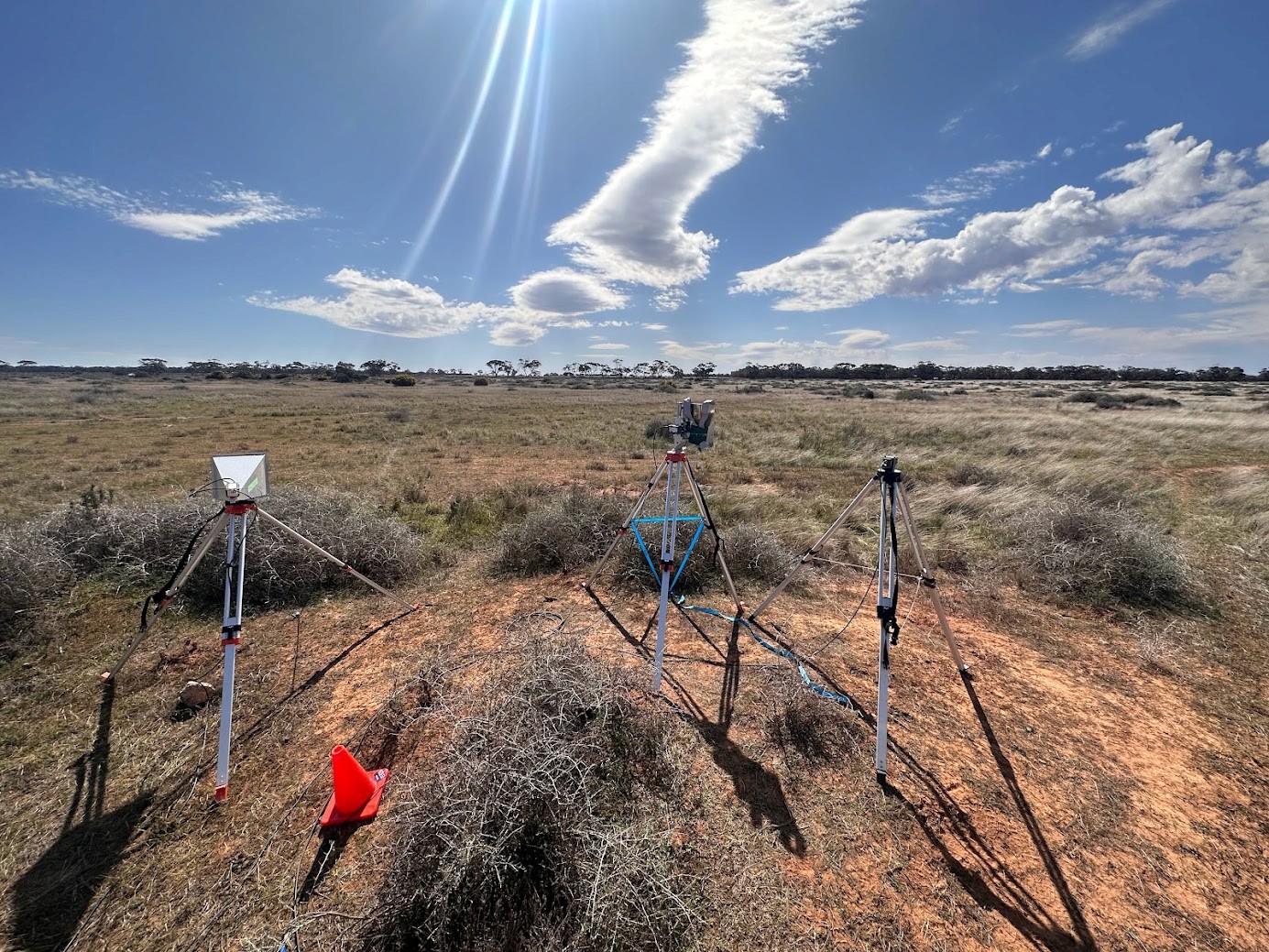
The program includes significant Australian collaboration. The antennas were manufactured in Australia, in partnership with printed circuit board (PCB) fabrication vendors, and the antennas were tested with commercial and government partners. Silentium Defence, a passive radar company, supported the testing of the metasurface antenna prototype through a passive radar demonstration at their test range in the Outback Desert. Passive radar is a type of sensing in which you use "sources of opportunity" (i.e. signals transmitted from other sources) in place of transmitting signals yourself. This operation thus avoids revealing your location, due to the fact that you are not transmitting anything. In addition to passive radar testing, the antenna was thoroughly characterized in collaboration with the Australian government.
The results from these test campaigns showed strong performance. The antenna technology was easily integrated within a passive radar framework and provided novel demonstrations of its use. The antenna characterization results showed high efficiency - a key characteristic for good performance on orbit. Overall, metasurface antenna technology has been advanced strongly through this program and shows great potential for Earth observation.